New England Venture Funded Medical Device Startup List 2013 Q3

English: Fall in New England.
Fall in New England. (Photo credit: Wikipedia)

According to PWC’s recent quarterly MoneyTree report, no new medical device companies achieved Series A fundings in New England in either Q2 or Q3 2013. Zilch, zip, zero, nothin’, no, nada.

I’ve been tracking first-time venture financing of medical device companies in Nw England since 2005. You’ll find the link to my latest list of these companies at the bottom of this post. I wish I had a better update to offer.

What’s causing this New England drought?

Continue reading “New England Venture Funded Medical Device Startup List 2013 Q3”

Engineering Is Not Product Development

Every once in a great while I read something so well stated that I put down my book/ipad/kindle and just reflect.

So when I recently read a post from Mike Sellers on Quora, I had to share it with you. Mike was responding to the question “As first time entrepreneurs, what part of the process are people often completely blind to?

Mike wrote beautifully about software companies (read his original post here).

I’d tweak his words slightly for medical devices. Here’s my modified version of Mike’s post: Continue reading “Engineering Is Not Product Development”

Medical Device Startups: Extraordinary Outcomes, Extraordinary Effort

Deserve victory

My blog has gone pretty quiet for the last couple of months – an effect of the pace of a high-performance startup. After all, extraordinary achievement requires extraordinary effort.

We start new medical device companies to achieve extraordinary outcomes:

For patients, dramatic improvements in mortality, morbidity and quality-of-life.

For physicians, new and better options for patient care.

For providers and payers, meaningful reductions in the cost of care.

For our investors, healthy returns on investment.

For our families, providing for our future.

For ourselves, the exhilarating experience of extraordinary achievement.

And it truly is exhilarating. Continue reading “Medical Device Startups: Extraordinary Outcomes, Extraordinary Effort”

Hospital System Consolidation: Will Your Medical Device Sales Model Adapt?

A physician visiting the sick in a hospital, G...
A physician visiting the sick in a hospital, German engraving from 1682 (Photo credit: Wikipedia)

About two years ago I noted “The Looming Impact of Healthcare Service Consolidation.” That consolidation ramped up this week, as the second-largest U.S. hospital chain, Community Health Systems, announced it would buy Health Management Associates (which operates 71 hospitals) in the largest hospital acquisition since 2006.

Consolidated systems standardize practices across hospitals and centralize purchasing of new technologies. Yesterday’s physician-champion-decision-maker is being replaced by tomorrow’s hospital-exec/technocrat-decision-maker. Medical device companies can learn a lot from enterprise IT sales.  Will your medical device sales methodology adapt?

Pitchbook Forecasts Tough 2013 for Medical Device Venture Funding


Pitchbook Second Quarter 2013 US VC Data Life Science Deals

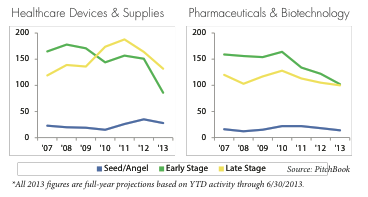
Pitchbook released their  “Second Quarter 2013 U.S. Venture Capital Data” last week, and the outlook for medical device venture deals continues to be difficult. Based on first half actual data, Pitchbook forecasts that the total number of early stage device deals in 2013 will hit a six-year low – a steep drop from 2012 and about half of the 2008 peak.  Pitchbook forecasts that the number of late stage deals will drop, but not as far – slightly down from 2012 and only at a five-year low.   Unfortunately, I can’t say I’m surprised.

Source: full report here.

There’s a Medical Device For That

English: Foldable, acrylic Intraocular Lens

Like virtually all cataract surgery patients, my parents were thrilled with their cataract procedures. Why not? After a quick office procedure, their new intraocular lenses (IOLs) gave them  better vision than they had experienced for more than a decade.

Now imagine a world with no devices for cataracts, only drugs.  Imagine taking one or more medications every day for the rest of your life – drugs which could not cure cataracts, but which slow the inevitable progression towards blindness. Imagine the typical chronic-medication side effects: somewhere between minor discomfort and an increased risk of cardiovascular mortality.  How does that sound?

When given a choice, I’ll take medical devices over drugs every time. Here’s why.

Continue reading “There’s a Medical Device For That”

Startup Medical Devices Change the World

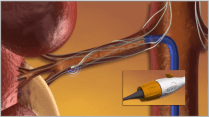
RDN Procedure 2 - Catheter-based Energy DeliveryIn case you aren’t paying attention, novel medical devices are changing the world. Some recent clinical trial headlines:

Ardian’s Renal Denervation System Demonstrates Sustained Blood Pressure Reduction at 30 Month Follow Up

Asthmatx Bronchial Thermoplasty Provides Long Term Asthma Control Out to 5 Year Follow Up

Percutaneous Valve Technologies’ and CoreValve’s Real World Registry Data Show That Transcatheter Valves Dramatically Improve New York Heart Association class III/IV symptoms and Angina

Barrx’s Endoscopic Ablation Therapy Eliminates Precancerous Esophageal Tissue and Significantly Reduces Disease Progression In Patients with Low Grade Dysplasia

EndoGastric Solutions’ Incisionless Endoscopic Procedure Significantly More Effective at Eliminating Chronic GERD Symptoms than Maximum PPI Dose, New Data Show

CV Ingenuity’s drug-eluting balloon demonstrates good 12 month efficacy in peripheral arterial disease.

Making a real and lasting impact – that’s what medical device startups are all about.

That’s why I do what I do.

Medical Device Venture Funding Trends – Q1 2013

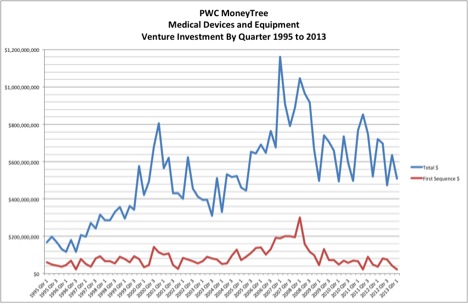
PWCMoneyTree Medical Device Venture Investments 1995-2013The latest quarterly MoneyTree Report was just released, providing some insight into the state of medical device venture funding in the US. I downloaded and plotted the historical trend data for medical device VC investments in the U.S. from Q1 1995 to Q1 2013.  Click on the thumbnails for larger images.

What do the trends tell us?

Continue reading “Medical Device Venture Funding Trends – Q1 2013”

Star Medical Device Engineer – Experimental Protocols

My colleague Chris recently noted: “the right way to do things is often a pain in the butt.” No question that most engineers see protocols as a pain in the butt – yet another file to sherpa through the document approval process.

There’s an important logic behind the practice of doing protocols. Imagine doing an experiment on humans (aka a clinical study) without one. But “good product development practice” isn’t the only reason star medical device engineers write protocols. Believe it or not, star medical device engineers view protocol writing as a key element of team leadership and team effectiveness.

Let me explain. Continue reading “Star Medical Device Engineer – Experimental Protocols”

US OIG Warns on Physician Owned Distributors

USDOJ Office of the Inspector General Seal

In 2011 I urged extreme caution for medical device companies considering  selling products through physician-owned distributorships (Caution: Physician-Owned Distributorships Ahead).  This week, the US Office of the Inspector General (US OIG) issued a fraud alert for physician-owned distributorships, stating that “OIG views PODs as inherently suspect.”  Don’t say I didn’t warn you.